Recorded results by animal group
A single herd tracked from late October to late January. The teal line is the RG92 group, the grey line the control.
All four operating metrics improved in the RG92 group.
| Metric | Control | RG92 |
|---|---|---|
| Production Score | 361.23 | 402.43 |
| Average weight (kg) | 3.081 | 3.252 |
| Feed conversion ratio | 1.652 | 1.623 |
| Rearing rate | 94.9% | 98.4% |
Mortality fell sharply and final yield reached 80%. Increased surface mucin and higher immune expression were also observed.
| Metric | Control | RG92 |
|---|---|---|
| Average weight (g) | 687 | 1,021 |
| Feed conversion ratio | 0.81 | 0.64 |
Three feeding regimes compared on one farm. The daily-RG92 group recorded no losses at all.
Faeces from the RG92 group showed high concentrations of short-chain fatty acids.
Full results table
choose an animal group| Subject / location | Metric | Result vs. control |
|---|---|---|
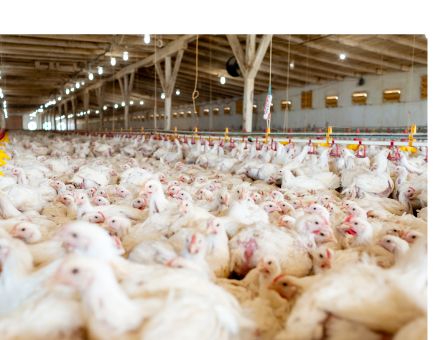
| Broilers — Miyazaki, 200,000 birds, 5 cycles | Survival, FCR, Production Score | Survival +1.6–7.2%; FCR improved 1.5–4.9%; P.S. +3.3–11.4%, repeated across cycles |
| Broilers — Thailand, 70,000 birds | Intestinal length, respiratory disease | Intestine +15% longer (+32 cm); respiratory disease down 63% (0.10% vs 0.27%) |
| Broilers — Gunma, 52,000 birds | Weight, FCR, daily gain | Average weight +7%; FCR improved 3%; DG +7% |
| Broilers — pooled across all trials | Weight, Production Score | Average weight +236 g (2,736 → 2,974 g, up 8.7%); Production Score +51 points. The main driver is better feed conversion, which means lower feed cost |
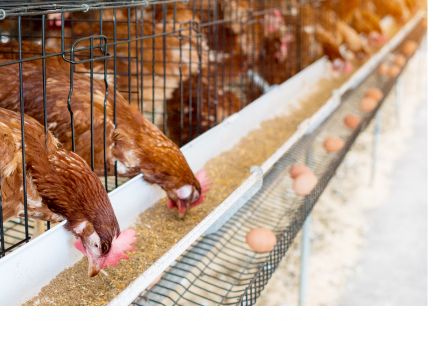
| Layers — several breeds (Boris Brown, Taiwanese lines…) | Lay rate, defective eggs, shell quality | Lay rate +2.9–10.5%; defective eggs down by up to 28.4%; stronger shells |
| Layers — Saga, Boris Brown breed | Eggs laid | RG92 group produced 52,127 eggs versus 51,810 in the control, a difference of +326 |
| Layers — SARABiO, birds 1,200 days old | Lay persistence, faecal SCFA | RG92 group laid one egg per 1.5 days versus 4 days in the control; faecal SCFA significantly higher |
In a separate study with Prof. Yoshiyuki Ohta (Laboratory of Animal Production Chemistry, Nippon Veterinary and Life Science University, board member of the Japan Poultry Science Association), RG92 water was injected into eggs on day 18 of incubation: RG92 eggs hatched a full day earlier than the control, and the newly hatched chicks weighed more. This points to mitochondrial function being switched on as early as the embryonic stage.
Joint research with Prof. Kohzy Hiramatsu (Faculty of Agriculture, Shinshu University) found thicker, shorter intestinal villi in the RG92 group, increasing absorptive area, alongside reduced incidence of infectious coryza and E. coli disease in native chickens. A peer-reviewed paper on layers was accepted by the Japan Poultry Science Association in 2026.
| Subject | Scale | Key results |
|---|---|---|
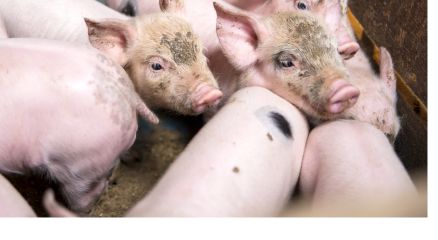
| Fattening pigs — Chiba | 34,600 head | Loss rate down 47.8% (from about 23% to about 12%). Colon tissue PCR showed significant differences in barrier and lipid-metabolism genes (Occludin), with elevated IL-1β |
| Fattening pigs — small herd | 150 head | The daily-RG92 herd recorded zero losses throughout the monitoring period |
| Prolific sow herd — Chiba, 2025 | — | Weaning-stage mortality fell sharply: 843 head versus 1,664 in the control |
| Cattle — pooled across herds | 531 head | Three-month calves gained +48.39 kg (446.72 kg vs 398.33 kg); some herds recorded no diarrhoea at all |
| Cattle — Gujarat, India (2024–2025) | — | Weight gain +13.8%, in partnership with Maharashtra University |
| Species | Key results |
|---|---|
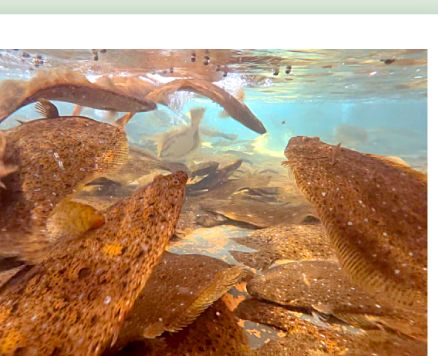
| Olive flounder (hirame) | Weight gain +334 g; higher inosinic acid for umami flavour; survival 35 points higher; production scaled 5× in three years |
| Mackerel (saba) | Hatched eggs increased 4-fold |
| Tiger pufferfish (torafugu) | Body weight reached about 117%; biting incidents fell as stress dropped |
| Whiteleg shrimp | Synergistic when dissolved oxygen is high; reached harvest size first among the trial groups |
| Rainbow trout (nijimasu) | Down over 90% in collision mortality; strong heat tolerance with no deaths at 24°C; improved water quality (Tokai University, Nihon University) |
| Eel (unagi) | Feed conversion ratio in stunted eels fell from 3.2 to 1.57; thicker skin mucin layer |
Why fish and eels secrete more mucus: RG92 activates mitochondria and raises ATP, giving goblet cells the energy to secrete more mucin. The thicker layer acts as a physical barrier against parasite attachment and bacterial invasion.
Return on investment for producers, as published by ONSOH
These are the highest figures recorded in each trial; they depend on local prices and costs and are not guaranteed.
Scale and species breadth
Poultry, swine, cattle and many aquaculture species; aquaculture alone accounts for roughly 5 million animals tested.
Reproducibility
FCR, survival, lay rate and diarrhoea incidence improved repeatedly across multiple cycles and multiple farms.
Published and ongoing research
- Flounder — Nobata S, Kino Y, Asao F, Nishimura S, Hamada S. Effect of a Microalga Mucidosphaerium sp. Strain RG92 Extract on Growth and Survival in Cultured Olive Flounder. SSRN preprint, 2024.
- Layers — Peer-reviewed paper accepted by the Japan Poultry Science Association, 2026 (per ONSOH documentation).
- Prebiotic mechanism — Teng Y. et al. Nature Communications 2025;16:1295. DGDG targets butyrate-producing bacteria.
- Identification — Bock et al. J. Phycol. 47:638–652, 2011 (18S rRNA).
- Ongoing — RNA-seq at Kanazawa University (Prof. Iwabuchi) on flounder intestine and kidney, layers and dairy cattle.